
Resources
Here you can find all blogs that have been published, in order.
What’s better?
What do you do when you start a discussion with a notoriously negative friend, a catch up with a colleague or a follow-up session with a client, and you ask the classic solutions-focused question, ‘What’s better?’, and your client replies, ‘Nothing really’?
This was one of the most popular topics at a gathering of solution-focused practitioners, and here are answers that the group of consultants, coaches and therapists came up with:
- ‘So, how have things been?’ – to open up the conversation, and hope there’ll be something positive to build on from the reply to this question
- ‘OK, and can you say why you decided to come back?’ – taking a tack of curiosity, expecting that the person will reveal their hopes in attending this session
- ‘Nothing really… so perhaps something…’ – taking the person’s exact words and playing lightly on the idea that nothing really is not the same as nothing. This one has the virtue of persisting with a question that you felt was worth asking
- ‘OK, I guess you’ve had some better moments; what’s the highest you’ve been on the scale this week’ – searching for the highlights, given that the week will have had its ups and downs
- ‘Since we last met, what have you been pleased to notice about yourself?’ – inviting another look back at the time since last meeting with a view to unearthing some personally pleasing qualities
- ‘What improvements have you managed to hang on to?’ – a great question if there was previously progress, but the individual has now hit something of a dip
So when you’re on the hunt for progress ……..be persistently curious!
What conversational tactics do you use if you get a ‘Nothing’s better’ reply?
Blog by Paul Z Jackson, paul@thesolutionsfocus.co.uk
‘We need to talk about problems.’ Really?
There’s this persistent idea that people need to talk about their problems if they are ever to solve them.
It’s persistent because it seems so obvious. And that’s because, in one sense, it’s right.
It’s right in the sense that it’s impossible to know whether or not a problem has been solved unless that problem has been stated in some way.
But beyond this foundational logic there are many advantages to keeping talk about a problem to a minimum. For example, when not talking about a problem:
- We’re not enlarging its apparent difficulty by focusing on it
- We’re not re-introducing and magnifying the negative emotions associated with the problem
- We’re less temped to get into a blame game
- We can move more quickly into finding the resources which will fuel the solution
What does this mean in practice, say for coaches and consultants when talking to their clients?
For a start, it’s OK for people with problems to tell us what they are. Our clients may feel a need to share their history, and it’s important that they feel heard, so that they experience a good connection in their conversation.
The statement of a problem or issue helps set a context in which to look for solutions. We can be aware that solutions, while including the problem vanishing, may be much more wide-ranging, featuring bigger improvements and other forms of progress. What’s wanted is often more than the absence of a problem.
So no one taking a Solutions-Focused (SF) stance would ever say, ‘We don’t want to talk about what happened’. In SF, the client decides what they want to talk about, not the practitioner. And an SF practitioner would certainly hear what happened if the client wanted to express it.
Indeed, a cornerstone SF aphorism is, ‘One foot in acknowledgement, one foot in possibility.’
Nonetheless, we favour Solutions Talk over Problem Talk. Yes, many people think that talking about the problem helps to find the solution – and perhaps it might. But what if we could talk about what the client wants as a result of such talking (the solution), and by these conversations we can fix the problem without talking about it, would that be OK?
That’s what SF offers. Again, in practice, instead of analysing or complaining about problems, we can make more effective use of our valuable conversation time by talking about:
- What the client would like to be happening with respect to the topic they bring
- What the client has done that’s been successful with regard to that topic.
- What others have done that have worked and might be borrowed
- What they’ve done with similar issues that could be reapplied here
- What they think might be a good next step.
Any of which might be the clue to solving the (not-much-talked-about) problem. Or towards making such good progress on multiple fronts that the problem vanishes, overwhelmed by new, preferable activities, or retreats into less significance.
As a result, with this approach, we hear clients say:
‘I’m no longer bothered by my poor spelling because I’ve found a great editor and have worked out how to use spell-checkers on my machine.’
‘I still can’t find my first pair of slippers, but I keep my feet warm with other slippers left at strategic points around the house or I simply wear socks.’
‘I don’t know why I was drinking so much alcohol, but now I’m taking exercise and enjoy a much healthier diet.’
Blog by Paul Z Jackson, paul@thesolutionsfocus.co.uk
Does a Solution-Focused approach eliminate all problems?
Solutions Focus is often described as a positive approach. But it’s not a promise that everyone will be happy all the time. We can still expect people to be challenged by problems and suffer their social, physical and emotional consequences.
What SF does offer is a choice about how to respond. And the conversation can point to the likely consequences of that choice. If we choose to follow the Problem, by analysing it at length for example, we’ll reside in the world of the problem. If we select the Solutions route, we’ll enter the world of what’s wanted (instead of the problem). That may be a positive desire for something different, a sense of possibility and the fuel of hope to set light to the resources that can take us forward.
Of course, people tend to get wrapped up in their very immediate problems. They know they don’t want the problem and its consequences, but may struggle to describe what they want in its place.
That’s where our work as practitioners begins. And it can be quite messy to start with, getting clear about the project that’s worthy of the clients’ attentions. Even if you switch the conversation from problem talk to solution talk, there’s more skill needed to turn vague ideas and concepts into detailed descriptions of the more desirable future.
If you work with groups, for example, different people will have different preferences and priorities. Still it’s useful to discover who wants what. The common ground is then a shared platform or starting point. Working together on elements we all want is often a productive way of harnessing collective resources and building momentum for outstanding achievements.
Blog by Paul Z Jackson, paul@thesolutionsfocus.co.uk
What’s different about Solutions Focus?
What’s different about SF? Quite a lot, it turns out. And one huge starting distinction is that we choose to ask different questions from practitioners of other approaches.
Here’s a situation that was presented in a discussion group I subscribe to. I’ve edited the contributions slightly to simplify.
‘Students in a nearby university will be organized into teams of four to work together on a project for the next 3 months. While they know each other, they have never worked together as a team and most have never worked in any team situation. They will be under a great deal of pressure during their time as a team to complete a project in a highly competitive atmosphere. The idea is to replicate what they will experience in the work world once they graduate, i.e. the intensity of working in teams, meeting deadlines and being highly creative.
‘I have been asked to spend a day with the students hosting team building activities/exercises to help them develop some skills to work better as teams and to avoid potential destructive elements that can emerge. Any ideas/suggestions you might offer will be most appreciated.’
You probably have your own initial ideas of what you’d do here. Here’s what one of the leaders of a particular non-SF approach recommended:
‘It occurs to me that a bit of understanding about the ‘Groan Zone’ could be helpful. I hear from lots of folks – knowing it is coming, and some awareness that the discomfort is part of the creative process saves them from giving up, imploding and attacking each other.
‘This is a place I would also do some fear work – notice what my own fears are and what our collective fearful thoughts are and work with those.’
Now those topics might or might not prove useful, but the suggestions would inevitably turn the group’s attention to discomfort and fear, with all the accompanying negative effects on mood and feelings of competence.
So here is what I replied, injecting a dose of solutions orientation in contrast to the problem-laded assumptions of the above:
‘I’d also warn them to look out for the ‘Arena of Delights’, in which they may notice fragments of resources, things going well, evidence of collaboration, small signs of success, glimpses of useful possibilities.
And perhaps add some resilience work – notice in challenging times when we are feeling we can cope a bit, where there are glimmers of hope or light, and work with those.’
When you grasp this basic contrast between ‘Problem Focus’ and ‘Solutions Focus’, you’ll enjoy plenty of constructive ideas for specific questions you can ask in any circumstance – and will make a worthwhile difference to all the people you engage with.
Blog by Paul Z Jackson, paul@thesolutionsfocus.co.uk
Three contexts of solutions Focus
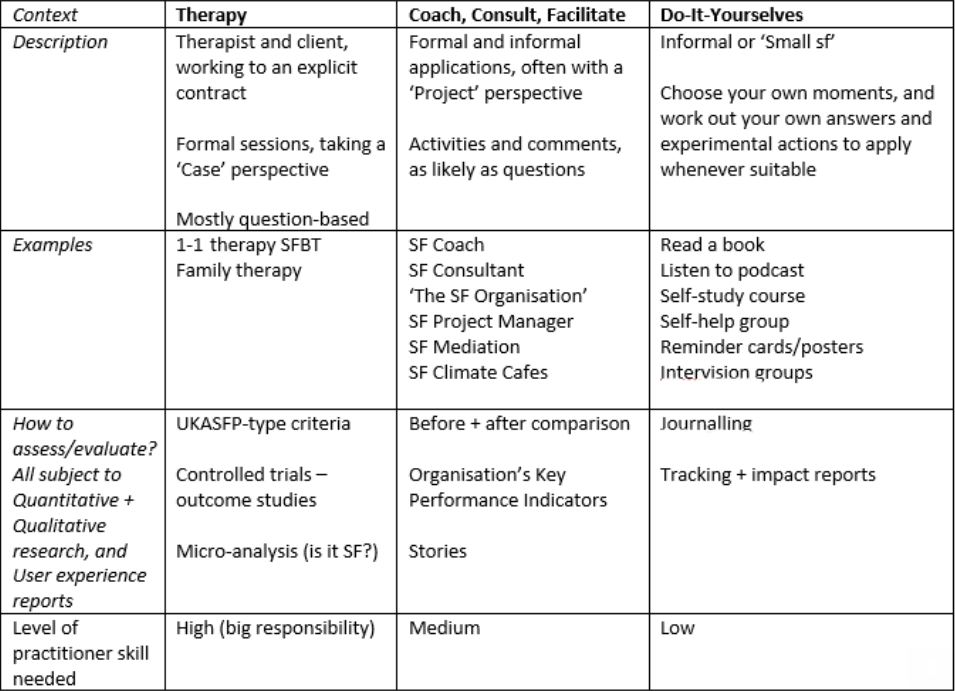
Our field got its name with the introduction of Solution Focused Brief Therapy by Steve de Shazer, Insoo Kim Berg and their colleagues. These days you can be someone who practices SF as a do-it-yourself guide to any moment of daily life. In between, many of us who are not therapists are professional practitioners of SF as coaches, consultants, leaders and managers.
Here’s a chart that describes 3 contexts in which people apply their SF approach
Contact Us
Do you have a question? Would you like to share your thoughts about the conference with us – or simply feel like connecting?
Get in touch with us at 📧conference@solutionfocus24.com